Why Game Design Belongs in Your Business Processes
Games are the most effective systems we have for keeping people engaged through hard, repetitive work. Applied with care, the same mechanics make business processes faster and less stressful. Applied carelessly, they become surveillance with a points table.
Games are the most effective systems we have for keeping people engaged through hard, repetitive work. Applied with care, the same mechanics make business processes faster and less stressful. Applied carelessly, they become surveillance with a points table.
The strangest thing about video games
Think about what people do in games, voluntarily, after a full day of work. They grind through the same level twenty times. They fill in inventories, optimise routes, coordinate with strangers at two in the morning. If you described it as a job, nobody would apply.
Then look at a typical business process. A ticket queue with no end. A compliance checklist nobody understands. A release process where you only hear about your work when something breaks. The tasks are often less tedious than the ones in a game, yet they drain people instead of absorbing them.
The difference is in how the work is designed. Games are built, very deliberately, around a few things our brains respond to. Most business processes are built around none of them.
What games get right
Strip away the graphics and every good game rests on the same four mechanics.
- A clear goal. You always know what you are trying to achieve right now, and what comes after.
- Immediate feedback. Every action has a visible consequence within seconds. You know whether it worked.
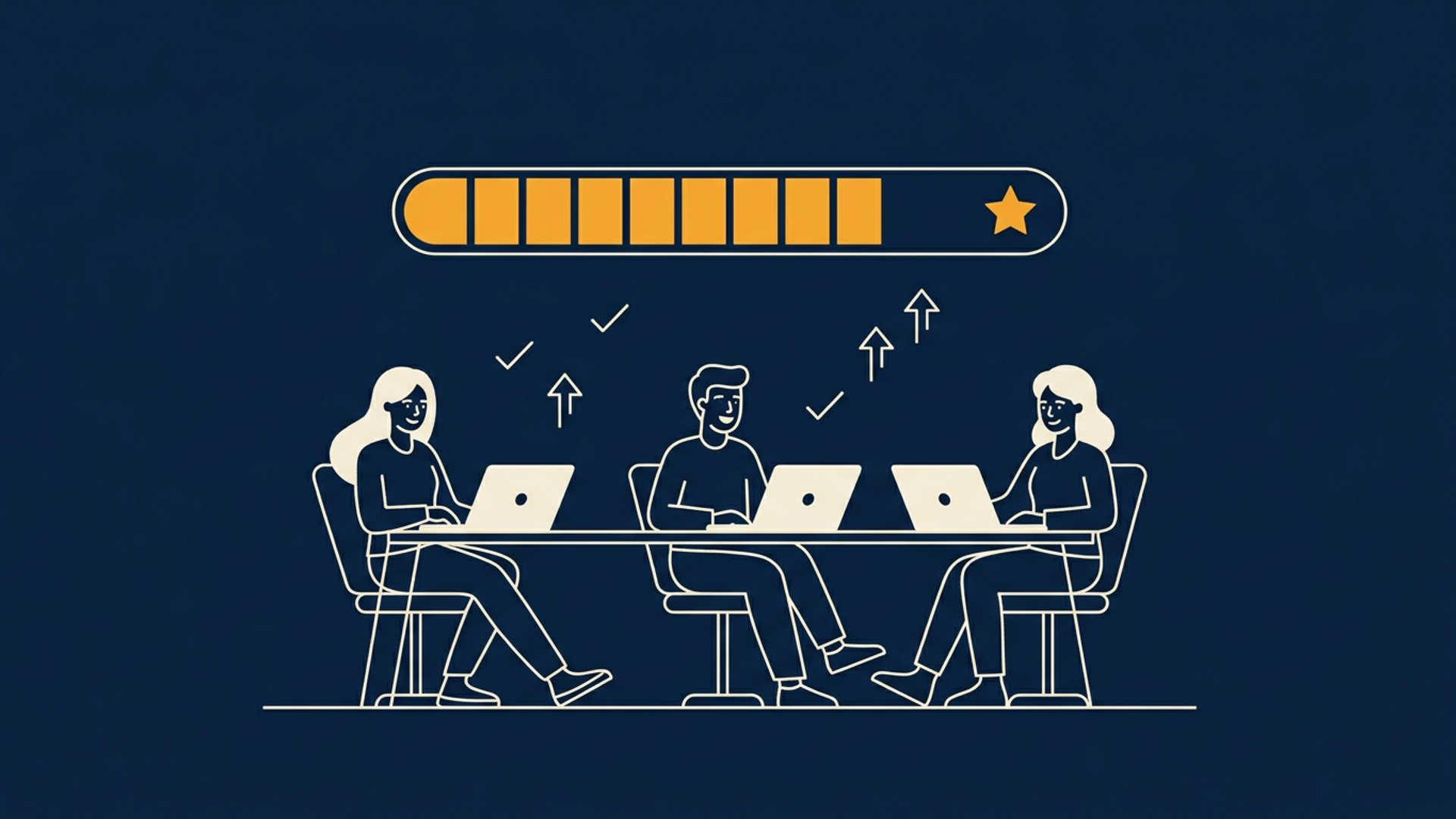
- Visible progress. A bar fills, a level unlocks, a map gets uncovered. Effort accumulates into something you can see.
- Challenge matched to skill. Too easy is boring, too hard is frustrating. Good games keep you in between, and raise the bar as you improve.
None of this is new to psychology. Mihaly Csikszentmihalyi described clear goals, immediate feedback and the balance between challenge and skill as the conditions for flow, the state in which people do their best work and lose track of time. Teresa Amabile's research on knowledge workers found that the single biggest driver of a good day at work was making progress on meaningful work, even small progress. She called it the progress principle.
Games are simply the industry that took these findings most seriously.
Why it makes work faster
Most delays in business processes have little to do with how hard the task is. They come from ambiguity and waiting.
People slow down when they are not sure what "done" means, when they wait days to find out whether their work was accepted, and when a large task gives no sign of progress until the very end. Each of these is a design problem, and each has a game mechanic that fixes it.
A clear goal removes the ambiguity: "close the twelve oldest customer requests this week" moves faster than "reduce the backlog". Immediate feedback removes the waiting: a check that tells you in minutes that your change is correct beats a review that arrives on Friday. Visible progress turns a large task into a series of small ones that get finished, instead of one big one that keeps getting postponed.
The effect compounds. When people can see the result of their effort quickly, they correct mistakes earlier, which means less rework, which means the whole flow speeds up.
Why it reduces stress
Stress at work rarely comes from effort alone. It comes from uncertainty and lack of control: not knowing whether you are doing well, not knowing how much is left, not seeing any way to influence the outcome.
Good game design attacks exactly those three. Feedback replaces uncertainty with information. Visible progress shows how much is left and how much is already behind you. A goal you can actually reach gives you a sense of control over the outcome.
There is also a quieter effect. Games give permission to fail. You lose a level, you try again, and nobody writes a report about it. Processes designed with the same spirit, where a failed attempt is cheap and expected, make people more willing to try, to ask and to fix things early, instead of hiding problems until they explode.
Where it works best
Not every process benefits equally. Gamification pays off most where work is repetitive, long, or easy to put off. Some examples:
- Onboarding. A new hire's first weeks become a path of small, visible milestones instead of a pile of documents to read.
- Technical debt. A shared map of the codebase where cleaned-up areas change colour turns a thankless task into a team effort with a visible finish line.
- Security training. Short challenges and simulated phishing campaigns, with instant feedback, beat an annual slide deck that everyone clicks through.
- Incident response. Practice drills run like a game day, with roles and a clear objective, make the real incident far less frightening.
- Customer support. Team goals on resolution quality, with progress everyone can see, give a sense of momentum to a queue that never ends.
AI agents make this even more relevant. As agents take over more of the routine work, what remains for people is supervision, judgement and the hard cases. That kind of work gives very little natural feedback: when everything goes well, nothing happens. Without deliberate design, it becomes invisible and exhausting. Making progress and good decisions visible matters more, not less, when machines do the visible part.
How to get it wrong
The research also carries a warning. Ethan Mollick and Nancy Rothbard studied gamification at work and found that it improved how people felt only when they accepted the game as fair and agreed to play. When it was imposed, it made people feel worse. A game you are forced to play is just work with extra rules.
The most common mistakes all come from forgetting that:
- Individual leaderboards. Ranking colleagues against each other creates winners, a large group of losers and an incentive to game the numbers. It adds stress instead of removing it.
- Points tied to pay or performance reviews. The moment the game decides your bonus, it stops being a game and becomes a target. People optimise for the points, not the work.
- Rewarding volume. Counting tickets closed or lines of code written rewards speed over quality. You get exactly what you measure, and you will not like it.
- Badges for everything. Rewards that mean nothing are noise. People notice quickly, and the whole system loses credibility.
Principles I would follow
If I were introducing game mechanics into a business process, I would start from these rules.
- The team plays against the problem, never against each other. Shared goals, shared progress, shared wins.
- Feedback first, rewards second. Most of the benefit comes from clarity and fast feedback. Points and badges are optional decoration.
- Reward outcomes and learning. Fixed causes, resolved customer problems, skills acquired. Not raw activity.
- Keep it voluntary and transparent. People should understand the rules, agree with them, and be able to opt out without consequences.
- Keep the game out of performance reviews. The data from the game is for the team to improve, not for managers to evaluate individuals.
- Start small and measure. Pick one process, change it, and check whether it got faster and whether people report less stress. If not, change the design.
The real point
Gamification has a bad reputation because too many companies tried to paste points and badges onto broken processes. That is decoration, and it fails.
The real lesson from games goes deeper: design work so that people always know what they are aiming for, see the effect of what they do, and feel themselves getting better. Do that, and work gets faster because there is less waiting and less rework, and less stressful because uncertainty gives way to progress you can see.
Look at the process your team dreads most. Then ask the question a game designer would ask: what would make someone want to play this?